From Family Nights to Twitter Fights: How Indian Reality TV Changed
There was a time when Indian television brought three generations into the same room. Antakshari made grandmothers sing, KBC made families hold their breath, and Sa Re Ga Ma Pa made living rooms emotional. Today’s reality shows are bigger, louder, and more dramatic — but they rarely bring families together. Somewhere along the way, Indian TV stopped being a shared experience.
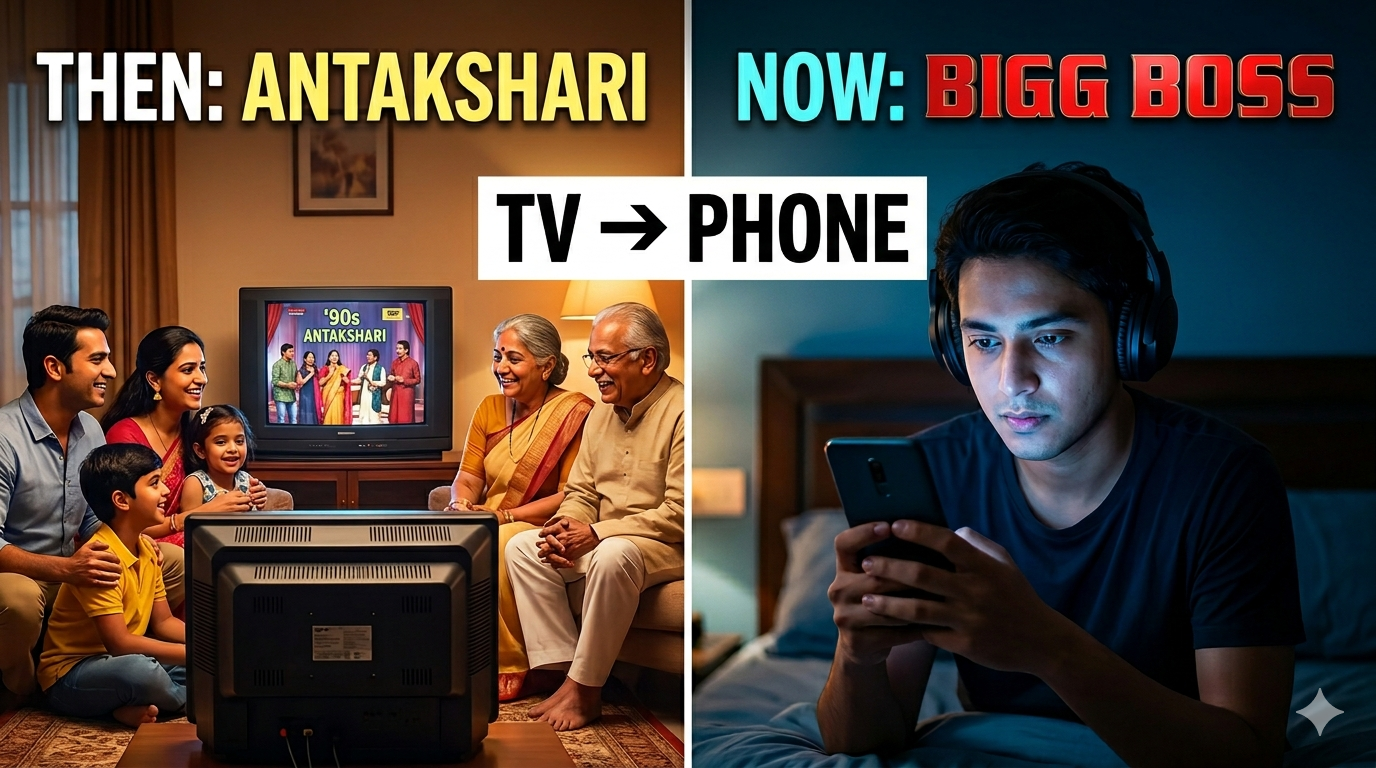
Antakshari to Bigg Boss: We Traded Family Nights for Twitter Fights
Ask anyone who grew up in India in the 1990s what seven o'clock on a weekday evening smelled like and they will not hesitate. Rotis on the tava.
Someone's mother shouting from the kitchen asking who changed the channel. A grandfather already parked in the good chair, the one closest to the TV, the one nobody else sat in without asking first. And from the television set, that iconic dhol beat of Antakshari rolling in like it owned the house.
Because it did own the house. For roughly an hour every week, that show owned every house in India simultaneously.
That is not a small thing to have lost.
The Show That Made Your Dadi Cry and Your Dad Sing
Antakshari was not just a game show. It was a time machine that happened to air on Zee TV. Annu Kapoor would introduce a team from, say, Bhopal, and within minutes your grandmother, who had not voluntarily spoken about her wedding in fifteen years, would be singing the exact song the contestant chose and explaining to nobody in particular that this song played at her cousin's baraat in 1967.
Your father, who spent most evenings behind a newspaper, would lower it. Your kid brother who only knew Backstreet Boys would go quiet.
That is what the show did. It did not entertain different members of the family separately. It pulled everyone into the same emotional moment at the same time.
A fifteen year old and a seventy year old sitting in the same room, both knowing the same song, both feeling something about it, is a miracle of programming that nobody has managed to repeat in twenty years of trying.
The contestants were not celebrities. They were a schoolteacher from Nagpur and a retired government clerk from Patna and a group of college girls from Chandigarh who screamed every time they got one right. And you were invested. Genuinely, embarrassingly invested. Because they were people your family recognised. They looked like your relatives. They sang songs your family sang. The distance between the screen and the sofa was almost nothing.
The Night KBC Made a Nation Hold Its Breath
September 2000. Amitabh Bachchan sits down across from the first contestant of Kaun Banega Crorepati and every television set in India that can receive Star Plus is switched on.
What followed was something India had never seen before and has never quite seen since.
A quiz show that managed to make intelligence feel like the most thrilling thing in the world. A host who treated a bus conductor from a small town with the same dignity he would give a prime minister. A format where the lifelines were not just game mechanics but genuine moments of human drama.
Remember Phone a Friend? The whole family would sit there calculating. Who would you call? Who do you know who is smart enough? Your mother would suggest your uncle who was good at general knowledge. Your father would counter that under pressure he would freeze. And somewhere in India, a contestant's phone was actually ringing in someone's actual house, and that person was picking up and trying to think straight with their heart hammering, and you could feel every second of it from your sofa.
KBC made ordinary Indians feel like they were part of something. Not watching something. Part of it. And when a contestant from a village nobody had heard of won a life-changing amount of money, the reaction in living rooms across the country was not polite applause.
It was the kind of noise families make when something real happens.
Sa Re Ga Ma Pa and the Kid Who Made Your Mother Sob
Before Indian Idol turned singing competitions into elimination theatre, Sa Re Ga Ma Pa was doing something quieter and considerably more powerful. It was finding children and young people from places the Hindi film industry had never bothered to look, sitting them in front of a microphone, and letting them sing.
The results were occasionally so beautiful that they broke something open in the people watching.
A twelve year old from a small town in Rajasthan singing a Lata Mangeshkar song with a voice that had no business coming out of someone that age. Your mother wiping her eyes and pretending she had something in them. Your grandfather sitting up straighter and saying something like they do not make singers like this anymore except this one, this one is something.
Sonu Nigam was a contestant on this show before he became a judge on it. That single fact tells you everything about what the show was actually doing. It was not manufacturing stars. It was finding them.
Govinda Showed Up and Chaos Became Prime Time
If Antakshari was the emotional heart of 1990s family television, Jeeto Chappar Phad Ke was its loudest, most joyful, most completely unhinged cousin.
Govinda hosting a game show should have been a disaster. What it actually was is one of the most purely entertaining hours of television Indian audiences have ever sat through. The man arrived to every episode like he had been waiting his whole life for this specific moment. Prizes rained from the ceiling.
Confetti happened for no reason.
Contestants who had come expecting a quiz found themselves in the middle of something closer to a celebration that had already been going on without them and was delighted they could finally join.
The genius of that show was its generosity. It was not trying to catch anyone out. It was not building to a dramatic elimination. It wanted ordinary people to win things and it wanted everyone watching to feel happy that they did.
That is a remarkably simple idea, and it is almost completely absent from what passes for game show television today.
And Then Came Bigg Boss
Nobody is going to pretend Bigg Boss is not compelling television. It is. Extraordinarily compelling. The kind of compelling where you tell yourself you are just going to check what happened this week and forty five minutes later you are watching a fight about a hairbrush at one in the morning.
Bigg Boss 17 gave the country Munawar Faruqui.
Bigg Boss 18 gave us the Karan Veer Mehra and Vivian Dsena dynamic that had social media running in circles for weeks. The show has a gift for creating situations where real human behaviour surfaces under pressure and the results are genuinely fascinating if occasionally deeply uncomfortable to watch.
But here is the thing. Bigg Boss is a solo sport. You watch it alone or with people your own age who are equally invested in the same contestants. You cannot watch it with your grandmother because within ten minutes someone will say something that requires a conversation you do not want to have. You cannot watch it with young children for reasons that become obvious within the first episode of any season.
The show is brilliant at what it does and what it does is not designed for a room with three generations in it.
Khatron Ke Khiladi sends celebrities to do physically terrifying things in foreign locations and it is legitimately exciting television.
Jhalak Dikhhla Jaa has its moments of genuine beauty when a contestant who has never danced finds something in themselves on that floor. But they are all, in different ways, shows you consume rather than experience together.

What Actually Changed
The easy answer is that social media ruined everything and streaming fragmented the family and nobody sits together anymore. There is truth in that but it is not the whole story.
The deeper truth is that the shows changed first.
Somewhere in the mid 2000s, Indian reality television discovered that conflict generated more engagement than warmth.
That elimination was more dramatic than celebration. That the audience would lean forward more sharply for a fight than for a song. All of that is technically correct and it gutted something in the process.
Antakshari was built on the assumption that its audience was good. That they wanted to feel something together.
That a retired schoolteacher singing a Mohammed Rafi song deserved to be treated as television worth making.
Current reality television is built on the assumption that its audience wants to watch people fall apart, which is a fundamentally different and considerably lonelier premise.
The Chair Is Still There
Here is what nobody talks about when they talk about the golden age of Indian family television. The shows were not perfect. The production values were often rough. The formats were simple. By the metrics that modern television uses to evaluate itself, Antakshari was not sophisticated programming.
But it understood something that sophisticated programming often forgets. That somewhere in India right now there is a living room with a grandmother already in the best chair. A grandfather who claims he does not watch television but has not moved in an hour. A mother calling from the kitchen asking what is happening. Children who will remember this evening thirty years from now not because of what was on screen but because of everyone who was in the room.
That room is still there. It is waiting for a show that knows what to do with it.
Nobody has sent one in a very long time.
Loved this? Send it to a friend on WhatsApp 👇
One tap. Pre-written teaser. They'll thank you for the gossip drop.
Who Is Krish Agrawal? Ida Ali’s Fiancé and Her Film Career
Who is Krish Agrawal, Ida Ali’s fiancé? A verified look at his engineering and research career, Ida’s filmmaking work, and their engagement timeline.
Continue reading