When Jai Santoshi Maa Turned Cinema Halls Into Temples
In 1975, a low budget film turned cinema halls into temples and made Jai Santoshi Maa a nationwide phenomenon, reshaping faith and creating history.
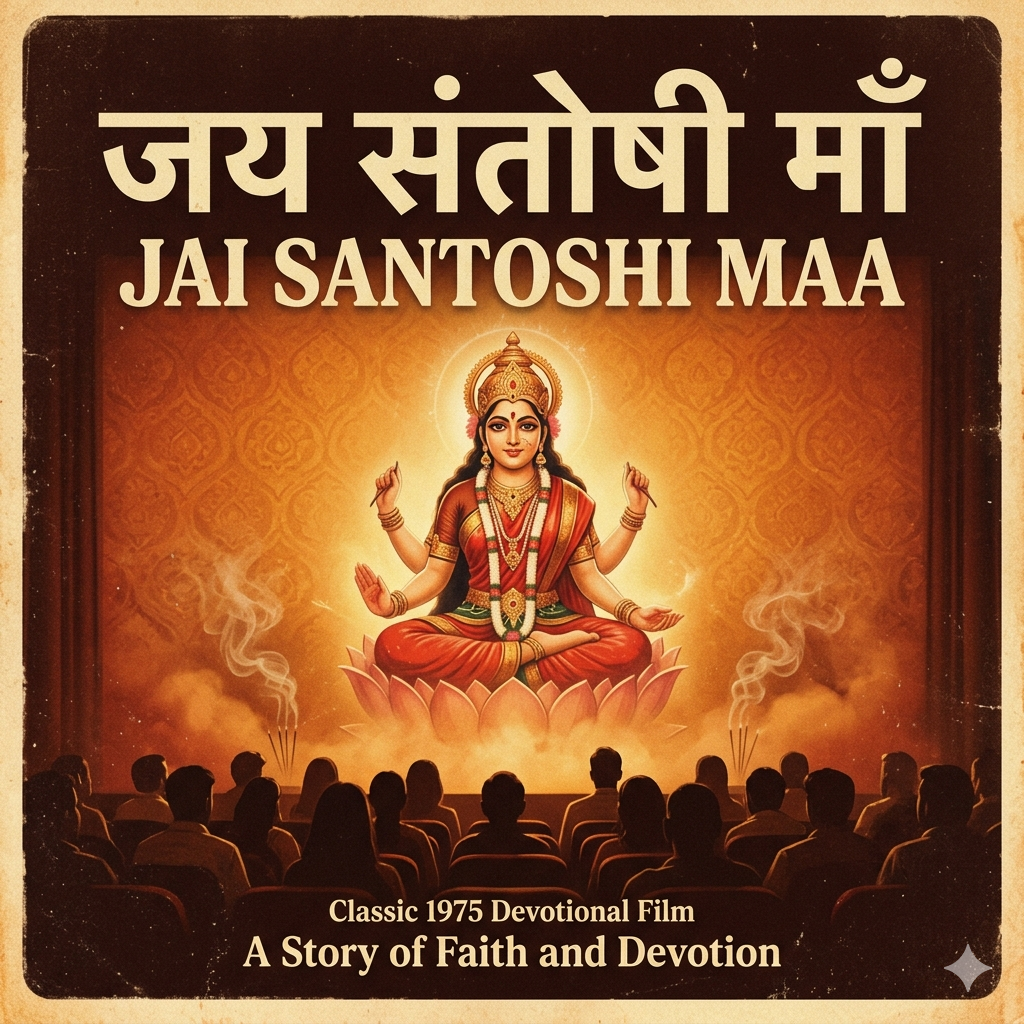
The Low Budget Film That Turned Cinema Halls Into Temples
It earned just ₹56 on its opening day.
No major distributor wanted to touch it. The cast was largely unknown. The budget was so thin that the entire film reportedly cost somewhere between ₹25 and ₹30 lakh to make. Critics who bothered to review it pointed out the shoddy special effects and melodramatic dialogue.
By every conventional measure, Jai Santoshi Maa should have quietly disappeared.
Instead, it became one of the strangest and most remarkable stories in the history of Indian cinema.
What Happened Inside Those Theatres
The film, originally dismissed with modest expectations, turned into a nationwide phenomenon through sheer word of mouth. And the word that spread was unlike anything the industry had heard before.
Cinema halls screening the film were transformed into makeshift temples, with patrons arriving barefoot, applying vermillion on their foreheads and distributing prasad after screenings. In some places, audiences performed prayers before the film even began.
Prasad counters appeared inside theatres, something unheard of in Indian cinema until then.
Viewers draped garlands over the cinema screen during showings and, in some cases, tossed coins as offerings.
In rural areas, entire villages organised trips to the nearest towns to catch a glimpse of the goddess on screen.
Traditional moviegoers were replaced by worshippers, many of whom wept during the film and sang bhajans in the aisles.
Kavi Pradeep's daughter Mitul, speaking about witnessing this herself, recalled it plainly: "I went to a local cinema hall to see the audience's reaction. I could not believe my eyes. Women and even men stood up when the song appeared on screen."
The Numbers That Made No Sense
The film was made on a budget of roughly ₹25 lakh and went on to gross over ₹5 crore, becoming the second highest-grossing Hindi film of 1975, after Sholay and ahead of Deewar. In terms of return on investment, it was not even a competition.
Sholay was made with ₹3 crore and earned ₹15 crore, roughly 400% profit. Jai Santoshi Maa made a staggering 2000% profit on its budget.
It was released on August 15, 1975, the same day as Sholay in Mumbai. The film that had no distributor willing to back it ended up sharing a release date with one of the most celebrated films ever made in this country, and held its own.
The Goddess Most People Had Never Heard Of
Here is where the story gets genuinely interesting, and where it requires some care to tell accurately.
Before 1975, Santoshi Maa was not a widely worshipped goddess across India. She existed in folk tradition and regional belief, particularly in parts of North India, but she had no major temples, no national presence, and no standardised ritual attached to her name.
The Santoshi Ma vrat katha, a ritual fast observed over 16 consecutive Fridays, had already begun spreading through word of mouth, pamphlets and posters in the 1960s.
But after the film's release, numerous temples dedicated to Santoshi Mata were established across India. While only about five such temples existed in North India before 1975, cities like Delhi now host at least 30.
The film did not invent the goddess. But it took her from the margins of folk belief and placed her firmly at the centre of national religious life.
Outside theatres, prasad was distributed, vrat-katha books were sold in huge numbers, and Santoshi Maa became a household deity. Songs like Main Toh Aarti Utaaru Re, sung by Usha Mangeshkar with lyrics by Kavi Pradeep, became integral to religious rituals, with many devotees incorporating them into their daily prayers.
That is not a small thing. A film reshaped the religious landscape of a country.
Why It Connected the Way It Did
Unlike the more extravagant mythological films of earlier decades, Jai Santoshi Maa was intimate, emotional and spiritual. It felt less like watching a film and more like experiencing a prayer.
The story at its heart was simple: a woman endures poverty, cruelty from in-laws and abandonment, and holds onto her faith. It was the story of a very large number of Indian women watching from those seats.
The goddess on screen was not distant or grand. She was responsive. She showed up.
That emotional truth cut through every production limitation the film had.
What the film lacked in advertising, it made up for with astonishing word of mouth. Its appeal extended beyond the religious. The emotional story of a woman's resilience resonated especially with female viewers.
Women formed the majority of its audience, and in many places, special female-only screenings were organised.
What Bollywood Never Quite Learned From It
In the fifty years since, Indian cinema has retold existing mythology many times over. It has given us grand retellings of the Ramayana, the Mahabharata, stories of Ram and Krishna and Shiva. But it has never again done what Jai Santoshi Maa did, which was to take a goddess living quietly at the edges of belief and bring her into millions of homes.
That kind of storytelling, where cinema does not just reflect faith but actively shapes it, is vanishingly rare. It happened once, in 1975, with ₹56 on opening day and bullock carts in the parking lot. And it has never quite happened again.
Also Read: https://bollybakar.com/article/the-saint-who-inspired-silicon-valley-gets-a-biopic
Also Read: https://bollybakar.com/article/the-return-of-mass-cinema-why-larger-than-life-bollywood-films-are-back
Also Read: https://bollybakar.com/article/is-luck-the-ultimate-ticket-in-bollywood-ten-times-a-star-said-no-and-handed-someone-else-a-legend
For more news, trivia, juicy bollywood gossips, subscribe to the youtube channel
https://www.youtube.com/@bollybakar

Loved this? Send it to a friend on WhatsApp 👇
One tap. Pre-written teaser. They'll thank you for the gossip drop.
Read this next
Trivia
Bollywood Actors Age List: Who Is How Old In 2026
Birth years and 2026 ages for Bollywood's biggest names — Shah Rukh Khan, Salman Khan, Deepika Padukone, Ranbir Kapoor, Alia Bhatt and more.
Continue reading